16 Hits
0 Comments

16 Hits
This is test blog for easysocial Integration
This is test blog for easysocial Integration
This is test blog for easysocial Integration
This is test

Today I’m excited to announce the 4th release of our open source icon pack, Ionicons, a hand-crafted set of premium icons for use across web, iOS, Android, and desktop apps.
Ionicons v4 is one of the first major icon libraries to be distributed as web components, with drastically reduced sizes, brand new icon forms reflecting the latest iOS and Material Design styles, and a continuous focus on ease of use.
 Icons
IconsIcons play a crucial role as a shared visual component and language used across nearly all apps. Limited screen real estate on mobile devices has made the use of icons a great way for apps to convey information while saving valuable space.
This was the driving force behind designing and open sourcing the first version of Ionicons. Our goal was to give Ionic developers an easy way to quickly build apps without worrying about where to find great looking icons for their interface. With Ionic, you get a collection of nearly 700 icons right out-of-the-box, across iOS and Android.
Since the original release, we’ve been thrilled to see developers adopt Ionicons in nearly every kind of app you could imagine. And with each successive version, our goal has been to make the icons and the experience using them even better than the last. With v4, we’ve taken some big leaps forward, and we think you’re really going to love it. Let’s dive in a bit…
All previous versions of Ionicons were intentionally inspired by and based on iOS 8+ / Android MD iconography. The goal is for the icons to provide a sense of comfort and familiarity to users on those platforms, by reflecting the stylistic forms they are used to. Ionicons are non-intrusive so as to not take away from the core experience but familiar enough to provide clarity.
With Ionicons v4, we’ve redesigned the iOS icons to better reflect Apple’s updated icon design guidelines, and gave MD icons a nice fine-tuning as well (MD icons are set for another update with MD2’s recent changes):
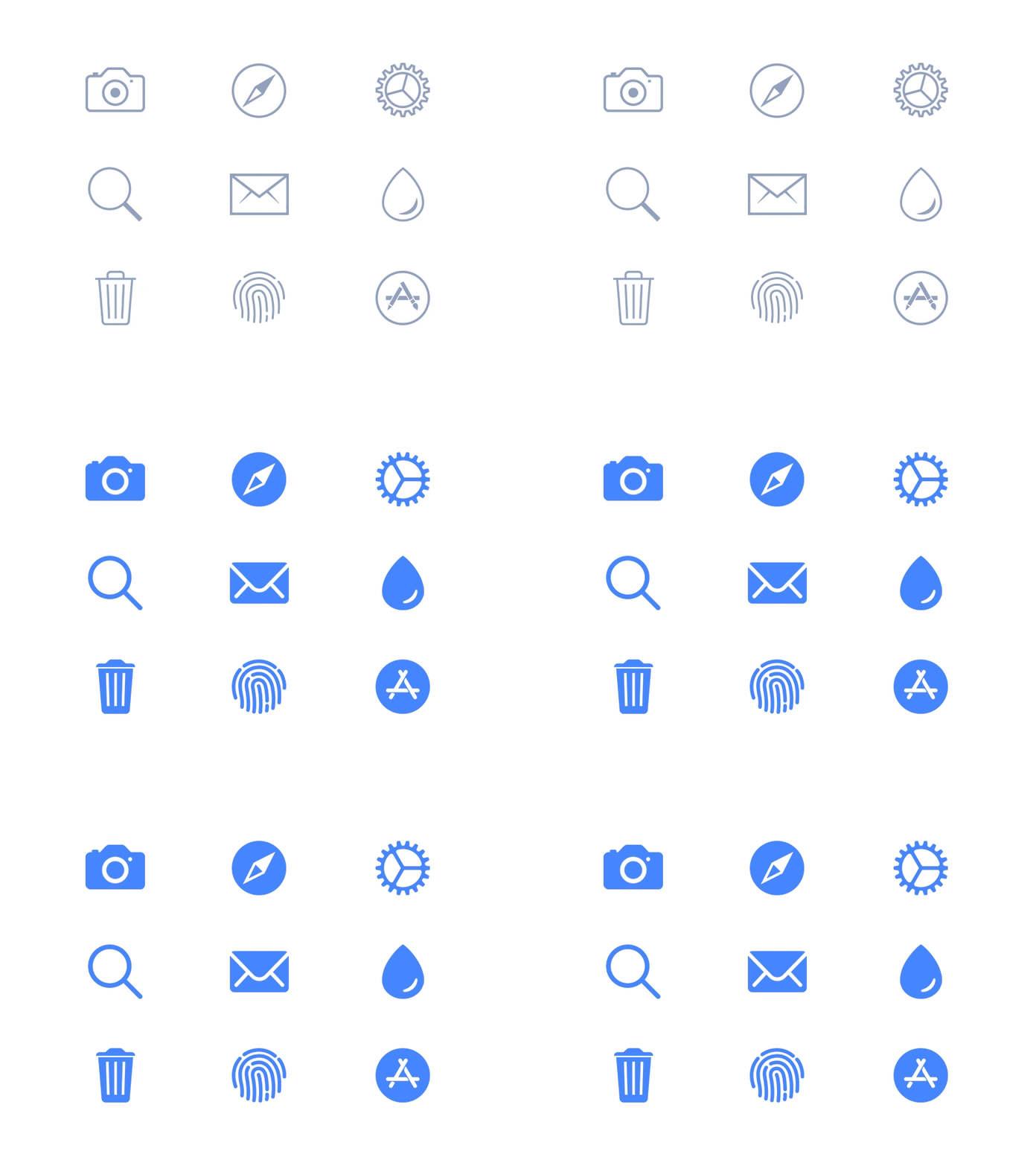
We also gave the Ionicons website a much needed UI/UX refresh – with better search, icon identification, and embedded usage docs!
When we originally released Ionicons, we went the route of making an icon font. At the time, this made a lot of sense: Icon fonts are vector-based, scalable to any physical size without pixelation, able to be styled with CSS, and come from a single resource (which means fewer HTTP requests).
While icon fonts are still a valid option in some cases, they also have a cost that can flip their advantage into a disadvantage: all of the icons are bundled in one file. And in previous versions of Ionicons, we were packing nearly 700 icons into one large file!
Why is this a big problem? Large font files have a negative impact on a webpage or app’s Time to First Paint, which makes for a subpar user experience and has been known to lower PWA Lighthouse scores. On top of that, adding any custom icons to a font icon is far from easy.
With Ionicons v4, we’ve made the leap to SVGs. All of the benefits of font icons (vector-based and styling with CSS) can be achieved just as easily with SVGs, but without all the baggage.
SVGs have been widely supported for many years, and are easy for designers to create themselves. The challenge has been, and continues to be, requesting external SVG files and still allowing them to be styled with CSS. The traditional <img> can work, but developers lose out on being able to change the color of the icon with simple CSS. If only there was a way to build our own <img> element to do exactly what we want it to do…
With the next generation of Ionicons, we’re now able to use web components to take advantage of the good parts from both font icons and external SVGs. The ion-icon web component, or more specifically Custom Element, is able to lazy-load only the external SVGs being actively viewed by the user. By using web-standards rather than one specific framework, Ionicons is able to be used across all the frameworks, or no framework at all.
Instead of always downloading the entire icon pack, Ionic apps will now only load the very specific icons the app requires. Think of the component as basically an <img> built specifically for external SVG files, but with some added flare to improve performance.
For example, for browsers that support IntersectionObserver, only the SVGs which are in the viewable area are downloaded. When using the ion-iconcomponent with an Ionic Framework app, it’s able to dynamically decide if the icon should use the iOS or Material Design variant. By using web components, we’re able to wrap up all this logic so it’s very easy to use. It just works.
For more information on how Ionicons works and it’s API, please see our new Ionicons Usage docs.
We know what you’re thinking: “Not all browsers support Web Components.”
Luckily, this isn’t really problem! Apps can safely use Ionicons without worrying about browser support. Since ion-icon is built with Stencil, all of this is handled for you and only requests the polyfills when needed. In fact, in today’s web landscape very few users will even require polyfills at all, which means very little amount of code is required for the custom element for a majority of users. Please test it out for yourself on IE11 and above.
We’re thrilled about this new foundation for the project, which will allow us to keep improving on and adding new icons in the future. If you have any icons you’d like to see added, please create an issue here.
In the meantime, check out the new Ionicons.com, start playing with the new icons, and let us know what you think!

There are few places left on earth that are unaltered by man. One such place is the remote tundra and sparse taiga forests of Nunavik, Canada. Few have ever seen this strange land, where drinking water can still be dipped and supped right from the ultra-pure lakes and streams and where wild plants still exist undisturbed in a state of natural balance. Harsh winters dominate this remote northern country, sculpting the landscape at whim into graceful and delicate patterns. An abundance of natural activity, animal life and great peace prevails. Woven into the landscape is the vast sense of time unchanged. The tundra here lies in the vast Precambrian shield, a landscape of ancient bedrock-glaciated hills covered with lichens, wildflowers and in protected places, sometimes a variety of shrubs and dwarf trees. This is a story many thousands of years old and one intricately bound up with the relationship between the musk-ox, the caribou, the polar bears and sea life

This morning we released the results of the first-ever Ionic Developer Survey, with input from more than 13,000 community members who shared with us the tools and technology they use, and what types of apps they’re building.
The full data set is available on our site, along with our own insights and analysis.
First and foremost, let me say thank you to the community for your amazing support. We think the results of the survey will be really valuable for developers, and for the vendors featured in the results. We couldn’t have done it without your support, so thank you!
I also wanted to offer my perspective on what the results mean for the Ionic community and mobile development as a whole. While there’s lots of interesting data in the survey results, the dominant theme is simple: right now is a great time to be a web developer.

We are proud to announce the ATV Championship 2017 that's going live for the first time today! With all teams geared up it promises to be an exciting contest. We look forward to seeing all of you at the NC Stadium at 5 PM ! Lorem Ipsum is simply dummy text of the printing and typesetting industry. Lorem Ipsum has been the industry's standard dummy text ever since the 1500s, when an unknown printer took a galley of type and scrambled it to make a type specimen book. It has survived not only five

We are proud to announce the ATV Championship 2017 that's going live for the first time today! With all teams geared up it promises to be an exciting contest.

Color is always doing something. Sometimes color screams out a message, sometimes it casts a subliminal spell. So, what's happening in the world of color today? Yesterday? Tomorrow? What are the facts, what are the myths?
Featured entries
Color Matters Blog
Color is always doing something. Sometimes color screams out a message, sometimes it casts a subliminal spell. So, what's happening in the world of color today? Yesterday? Tomorrow? What are the facts, what are the myths?
Navigation
Posted by Jill Morton in Blogs & News
Pink has been all over the news recently. Some of it is powerful and inspiring but the same old dirty little lies about pink continue to be spread. We begin with color news you can’t use:
Liar Liar – The Color Wheel Is on Fire
(The same old nasty alternative facts about pink)
“Cool Down Pink”
The article states: "Are you quick-tempered? Have bouts of aggression? The reason could be lack of pink in your environment! According to psychologist Daniela Spath a certain shade of pink calms the nerves, including in aggressive prisoners."
So wrong!
...
Tags:
Rate this blog entry:
1
2
3
4
5
6
7
8
9
10
2
601 Hits
It’s not easy being lurid green
Posted by Jill Morton in Blogs & News
The Olympic swimming pool in Rio turned green last week. In spite of assurances that it was safe, athletes were appalled and observers describe it as swampy and sewerish.
Even though it’s back to its pristine azure blue, it makes you wonder about a color that is embraced as the symbol of nature and eco-awareness. Oh no, how can green turn lurid?*
This is a lesson for all color enthusiasts: The context matters as much as the symbolism of a color. Green means go in a traffic signal and good luck on a shamrock, but green racing cars can be unlucky, and a green swimming pool might just make you think that Kermit the Frog peed in the pool.
Posted by Jill Morton in Blogs & News
Typically people ask about the color of happiness, power, and other positive attributes. When a former student asked about the color of insanity, it deserved an answer. Here are a few things to ponder:
In Russia, a colloquial expression for an insane asylum is "yellow house" because (a long time ago) they used to be painted yellow.
"The Yellow Wallpaper" by Charlotte Gilman Perkins has been tied to a certain form of OCD. Furthermore, the color of the wallpaper has been explored in a number of scholarly literary papers.
Van Gogh's palette became more and more yellow towards the end of his life. His "insanity" was supposedly caused by lead poisoning because he inadvertently "ate" his paints ("hand to mouth" gestures, holding a brush handle in his mouth, etc.).

Reading is fundamental in developing a good self image. Reading not only enhances our knowledge but can also be nurtured as a really good hobby. Non-readers or poor readers often have low opinions of themselves and their abilities. Many times they feel as if the world is against them. They feel isolated [everybody else can read - which isn't true] and behavior problems can surface. They can perform poorly in other subjects because they cannot read and understand the material. Often the reader tends to "give up." Hence reading is of utmost significance

Basic" may have adapted a negative connotation in recent years, but there's no shame in seeking advice on theoretically simple sartorial conundrums. In our latest column, "Back to Basics," we're here to guide you through life's most common (and important) fashion and beauty concerns.
BACK TO BASICS: HOW TO BE A FASHION BLOGGER
Here are some practical tips and tricks from the 2016 Bloglovin' Awards finalists for H&M's Breakthrough Fashion Blogger of the Year.
JUL 21, 2016
2.5K
SHARES
Taye Hansberry of Stuff She Likes. Photo: Courtesy of Stuff She Likes
"Basic" may have adapted a negative connotation in recent years, but there's no shame in seeking advice on theoretically simple sartorial conundrums. In our latest column, "Back to Basics," we're here to guide you through life's most common (and important) fashion and beauty concerns.
Since its genesis in the early aughts, fashion blogging has turned from a hobby to an incredibly lucrative business. Some of today's most influential personal style bloggers have garnered millions of followers, snagged six-figure campaign deals, landed on the cover of fashion magazines and launched their own clothing lines. Of course, it takes time, dedication and a lot of hard work to reach that level, but getting into the game is now easier than ever.
In order to help us break down what it really takes to get your site off the ground, we turned to this year's finalists for the Bloglovin' "H&M's Breakthrough Fashion Blogger" award for their best advice. The lucky group recently had the chance to meet with Leandra Medine of The Man Repeller for a mentorship session at the H&M showroom in New York City, and they were happy to share what they learned from the OG blogging guru. Read on to find out their biggest takeaways.
JUST START A FASHION BLOG ALREADY
With any creative project, sometimes the hardest thing is to simply sit down and start. We're often stuck in our heads, dreaming up ideas instead of making them happen. "I literally said 'I want to start a blog' out loud at a brunch, and I went home and started it that night," says Taye Hansberry of Stuff She Likes. Wordpress and Squarespace are easy platforms to use to launch a blog; eventually, when you want to take it to the next level, you can seek consultation from online strategists like Chloé Digital. The company advised Maristella Gonzalez of A Constellation to hone in on her blog's mission and aesthetic, which continues to help her come up with and create on-brand content.
BACK TO BASICS: HOW TO BE A FASHION BLOGGER
Here are some practical tips and tricks from the 2016 Bloglovin' Awards finalists for H&M's Breakthrough Fashion Blogger of the Year.
JUL 21, 2016
2.5K
SHARES
Taye Hansberry of Stuff She Likes. Photo: Courtesy of Stuff She Likes
"Basic" may have adapted a negative connotation in recent years, but there's no shame in seeking advice on theoretically simple sartorial conundrums. In our latest column, "Back to Basics," we're here to guide you through life's most common (and important) fashion and beauty concerns.
Since its genesis in the early aughts, fashion blogging has turned from a hobby to an incredibly lucrative business. Some of today's most influential personal style bloggers have garnered millions of followers, snagged six-figure campaign deals, landed on the cover of fashion magazines and launched their own clothing lines. Of course, it takes time, dedication and a lot of hard work to reach that level, but getting into the game is now easier than ever.
In order to help us break down what it really takes to get your site off the ground, we turned to this year's finalists for the Bloglovin' "H&M's Breakthrough Fashion Blogger" award for their best advice. The lucky group recently had the chance to meet with Leandra Medine of The Man Repeller for a mentorship session at the H&M showroom in New York City, and they were happy to share what they learned from the OG blogging guru. Read on to find out their biggest takeaways.
JUST START A FASHION BLOG ALREADY
With any creative project, sometimes the hardest thing is to simply sit down and start. We're often stuck in our heads, dreaming up ideas instead of making them happen. "I literally said 'I want to start a blog' out loud at a brunch, and I went home and started it that night," says Taye Hansberry of Stuff She Likes. Wordpress and Squarespace are easy platforms to use to launch a blog; eventually, when you want to take it to the next level, you can seek consultation from online strategists like Chloé Digital. The company advised Maristella Gonzalez of A Constellation to hone in on her blog's mission and aesthetic, which continues to help her come up with and create on-brand content.
Ashley Roiland of A Fashion Nerd. Photo: Courtesy of A Fashion Nerd
VISUALS ARE IMPORTANT
What's the saying? Behind every great fashion blogger is a great photographer? As style blogging continues to transform into a profitable business, so does fashion blog photography. Hansberry suggests finding a pro through social media and picking the one who you gel with the most. Taria-ann Verburgt of Survivor On Stilettosworks on a schedule with her photographer, picking a day that works best for both of them and then spending a few hours shooting different outfits, which creates about three or four new posts for her blog. You could also go the DIY route: When Amy Roiland of A Fashion Nerd was just starting out, she took all of the photos herself. "I would take a tripod, go out in the woods and do a whole photo shoot," she says.
AND SO IS STICKING TO A SCHEDULE
Consistency with posts is of upmost importance when you're starting out. Stick to posting something new on your blog two or three times a week. Or if you're feeling ambitious, aim to post every day, which will lead to more traffic. And don't second-guess yourself once you've hit the "publish" button. "Something that I would tell myself two years ago that I know now is to trust in my own work," says Jannel Therese of Street Style Teller. "I always was so skeptical to keep going, and now I know what I'm capable of doing."
WITH OTHER BLOGGERS
It might seem intimidating to join the vastly growing space of personal fashion blogs, but building relationships with your fellow bloggers will only help you thrive. To start, Verburgt likes to read and leave comments on other bloggers' posts. "It's nice to connect with other bloggers; you're in the same boat," says Jannel Therese, who often turns to her peers for input and advice. And don't forget to interact with those bloggers' fans, too: If you like the style of a particular fashion blog (or find the aesthetic similar to yours), chances are its readers will be drawn to your blog as well. Hansberry also suggests building your network beyond bloggers. "I don't think anybody should be counted out," she says. "Build relationships with a person who owns a boutique, an editor, your nail technician. You never know where it's going to go."

With New York Fashion Week just days away, you can bet our editors are busy nailing down their outfits. And while we prep our own ensembles, it's only natural that we've noticed a few standout trends we're expecting to make a major appearance on the streets of NYC. From the must-wear bag styles to the prints destined to make a splash, there are plenty of ways to make an outfit truly stand out, even when the crowd around you is ultra-chic.
Below, we're highlighting a collection of our favorite trends bound to make a major appearance at Fashion Week (and beyond!) this year. And while you may not have a front row seat, armed with an idea of the trends to watch out for, you can do a little pre-shopping to make sure you've got what you need to pull off the look too. Read on for some inspiration, along with a little shopping so you can pull off the NYFW street style look over the next few months too.

These days, work-life balance can seem like an impossible feat. Technology makes workers accessible around the clock. Fears of job loss incentivize longer hours. In fact, a whopping 94% of working professionals reported working more than 50 hours per week and nearly half said they worked more than 65 hours per week in a Harvard Business School survey. Experts agree: the compounding stress from the never-ending workday is damaging. It can hurt relationships, health and overall happiness.
Work-life balance means something different to every individual, but here health and career experts share tips to help you find the balance that’s right for you.
1. Let go of perfectionism
A lot of overachievers develop perfectionist tendencies at a young age when demands on their time are limited to school, hobbies and maybe an after-school job. It’s easier to maintain that perfectionist habit as a kid, but as you grow up, life gets more complicated. As you climb the ladder at work and as your family grows, your responsibilities mushroom. Perfectionism becomes out of reach, and if that habit is left unchecked, it can become destructive, says executive coach Marilyn Puder-York, PhD, who wrote The Office Survival Guide.
The key to avoid burning out is to let go of perfectionism, says Puder-York. “As life gets more expanded it’s very hard, both neurologically and psychologically, to keep that habit of perfection going,” she says, adding that the healthier option is to strive not for perfection, but for excellence.
2. Unplug
From telecommuting to programs that make work easier, technology has helped our lives in many ways. But it has also created expectations of constant accessibility. The work day never seems to end. “There are times when you should just shut your phone off and enjoy the moment,” says Robert Brooks, a professor of psychology at Harvard Medical School and co-author of The Power of Resilience: Achieving Balance, Confidence and Personal Strength in Your Life. Brooks says that phone notifications interrupt your off time and inject an undercurrent of stress in your system. So don’t text at your kid’s soccer game and don’t send work emails while you’re hanging out with family, Brooks advises. Make quality time true quality time. By not reacting to the updates from work, you will developing a stronger habit of resilience. “Resilient people feel a greater sense of control over their lives,” says Brooks, while reactive people have less control and are more prone to stress.
English: An artist's depiction of the rat race in reference to the work and life balance. See http://en.wikipedia.org/wiki/Rat_race Made with following images: http://www.openclipart.org/detail/75385 http://www.openclipart.org/detail/74137 (Photo credit: Wikipedia)
3. Exercise and meditate
Even when we’re busy, we make time for the crucial things in life. We eat. We go to the bathroom. We sleep. And yet one of our most crucial needs - exercise - is often the first thing to go when our calendars fill up. Exercise is an effective stress reducer. It pumps feel-good endorphins through your body. It helps lift your mood and can even serve a one-two punch by also putting you in a meditative state, according to the Mayo Clinic.
Puder-York recommends dedicating a few chunks of time each week to self-care, whether it’s exercise, yoga or meditation. And if you’re really pressed for time, start small with deep breathing exercises during your commute, a quick five minute meditation session morning and night, or replacing drinking alcohol with a healthier form of stress reduction.
“When I talk about balance, not everything has to be the completion and achievement of a task, it also has to include self-care so that your body, mind and soul are being refreshed,” says Puder-York.
These exercises require minor effort but offer major payoffs. Psychotherapist Bryan Robinson, who is also professor emeritus at the University of North Carolina at Charlotte and author of the book Chained to the Desk, explains that our autonomic nervous system includes two branches: the sympathetic nervous system (our body’s stress response) and the parasympathetic nervous system (our body’s rest and digest response). “The key is to find something that you can build into your life that will activate your parasympathetic nervous system,” says Robinson. Short, meditative exercises like deep breathing or grounding your senses in your present surroundings, are great places to start. The more you do these, the more you activate your parasympathetic nervous system, which “calms everything down, (and) not just in the moment,” says Robinson. “Over time you start to notice that in your life, your parasympathetic nervous system will start to trump your sympathetic nervous system.”

It’s meaning: We all know the popular saying “Health is Wealth”. By health we do not mean the absence of physical troubles only. But it is a state of complete physical, mental and social well-being. The loss of health is a loss of all happiness. Mahatma Gandhi also says, “It is health which is real wealth, and not pieces of gold and silver”.
Health is more important than wealth. A rich person can afford various luxuries of life such as a big car, large house, costly accessories, air-conditioners, etc. But, he can enjoy these luxuries only if his health is good.
Importance of light, air and water: Good health depends on several things. Fresh air and sunlight are very important for our health. Fresh air helps us to improve our immune system and overall health. So a morning walk is very useful for health.
Sunlight helps our body to produce vitamin-D. A dirty and damp atmosphere causes lots of diseases. Fresh and pure drinking water is also necessary for good health. Impure drinking- water is the cause of several diseases. So, we must take care of these things.

Think IoT is just for workouts and home security? Wrong! If you can't compile business data from internal and external sources, your ERP system is not making the digital grade. See why embedded intelligence makes ERP smarter for your business.
The Latest Trend to Stay Ahead
If the big names are using it, you know it's worth giving it a shot. SAP, Oracle and Microsoft are just a few of the companies that have embraced embedded intelligence and are combining the online world with the physical one in order to stay ahead. But what is IoT and how does embedded intelligence work in your ERP system?
How the IoT Works
The Internet of Things (IoT) really is as simple as it sounds. Just like you network with other people in your industry, clients, potential clients and friends, things can now network with other things to provide data for manufacturers, service providers and end-users.
A Fitting Example
Take Fitbit for example. What started out as a glorified pedometer in a bracelet has become one of the fitness industry's leaders in wearable technology. This little device that comes in the form of a watch, bracelet or pendant does everything but move for you. It tracks the calories you need to eat and the ones you burn, measures the length of workouts, monitors your heart rate, tells you where you are with built-in GPS and even controls your music. This information is collected, stored and shared so you can get the most out of your activities and stay in shape. So how does this calculate into your ERP system?
Getting Smart with Embedded Intelligence
Embedded intelligence works the same way. No, your ERP system isn't wearing a fancy wristband and running up and down the block, but it is getting a good workout by collecting data and providing it to you in real time so you can make great business decisions. Embedded intelligence uses wireless communication, microelectronics and sensor technology to integrate applications and monitor functions both inside and outside of your ERP system. This increases productivity and makes better use of all your resources.
Manufacturing a Smart Environment
For manufacturers, placing a chip in products that communicate with the ERP system accomplishes embedded intelligence simply and elegantly. The chip "talks" to the system while the product is still in the manufacturing process so that it provides data to the manufacturing execution system (MES). Combine this with other embedded intelligence sensors in manufacturing equipment and supply chain communication and you get a smart factory with more intelligent processes.
Keeping Smart Tabs
After the product leaves the factory, it generates product lifecycle management (PLM) information, which gives you powerful data about growth, maturity and decline that your business might not otherwise have access to. Information like how long a battery actually lasts, length of time a product is in use, what features are being used and what's being overlooked are no longer "best guesses" by customers on social media, but real-time stats that can help you improve your product and your strategies. Much more than sales data, MES and PLM data has become intelligent, real-time information that can take you to higher levels of success.
Using embedded intelligence allows your ERP system to stay aware of all of your business activities -- unbiased and in real-time. No more need to jot down notes while you're on the run; when you jump on the IoT, your ERP is already on top of it. Now that's a smart system.

The tiger is a unique animal which plays a pivotal role in the health and diversity of an ecosystem. It is a top predator which is at the apex of the food chain and keeps the population of wild ungulates in check, thereby maintaining the balance between prey herbivores and the vegetation upon which they feed. Therefore, the presence of tigers in the forest is an indicator of the well being of the ecosystem. The extinction of this top predator is an indication that its ecosystem is not sufficiently protected, and neither would it exist for long thereafter.
